


Auroville and Natural Dyes
A Journey by Pepe Barguñó
sdjnañsjnd

The first time I set foot in India, I was 22 years old and had three months ahead of me to explore it. Among so many cities and routes, there was one place that had always caught my attention but that I never managed to reach: Auroville.
A village apart, almost a country within India, born in the 1960s from the vision of those who wanted to build a different kind of community. From afar, I was fascinated by its philosophy: sustainability, respect for nature, and a way of life detached from industrial logic.
Years later, I returned with Thinking MU. Auroville was no longer just a name echoing in my mind; it had become a place I needed to visit to understand how they transformed tradition into something that fit our vision.
The first thing that struck me was the way natural dye is handled. It’s not a quick or automated process, but a series of decisions that require time, experience, and control, where the challenge isn’t just dyeing, but ensuring that the color properly adheres to the fiber.
Moreover, there was a challenge I had to overcome: the behavior of the color. Both there and elsewhere in the world, dyeing entire fabrics with natural dyes produces very noticeable irregularities in the final result. And that wasn’t our aesthetic. We weren’t looking for worn-out garments or obvious imperfections, but clean, carefully crafted pieces that aligned with the way we approach products at Thinking MU.


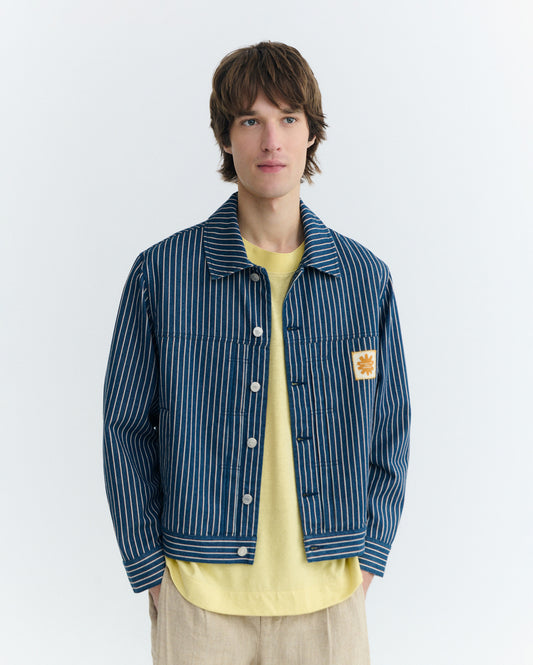
From that point on, we made a key decision: to apply the natural dye to the yarn rather than the fabric for the development of denim garments.
Denim has a very specific construction: the warp threads are dyed, while the weft threads remain undyed. This allowed us to achieve several things at once. On one hand, the small irregularities inherent to natural dye were much better integrated into the final fabric. On the other hand, the process became more sustainable, since only half of the threads are dyed, reducing the use of dyes and resources without compromising the final result.


The process is completed with cutting and sewing in our India factory, certified by GOTS (Global Organic Textile Standard), which ensures social and environmental criteria throughout the entire production chain. And this is how our Natural Dyes workwear-inspired capsule is born.
-
 Sale
Sale -
 Sale
Sale

Discovering Auroville and meeting the people who have been working with these processes for decades was a key learning experience. Supporting them is also a way to help keep these artisanal techniques alive, adapting to the times without losing their essence.
That balance between tradition, technical improvement, and sustainability is what we wanted to bring to Thinking MU. A conscious way of working with color, focused on control, aesthetic coherence, and lower impact, without losing sight of garment durability or the responsible use of resources.


